 Add to Chrome
 Add to Firefox
 Add to Edge
PatchWorld: Gradient-Free Optimization of Executable World Models
May 29, 2026
Text-agent environments are typically modeled as partially observable Markov decision processes (POMDPs), assuming that the simulator's latent state and transition dynamics are hidden from the agent. Yet little work has examined whether executable code can be induced to serve as a world model for prediction and planning under partial observability. We introduce PatchWorld, a gradient-free framework that turns offline trajectories into executable Python world models through counterexample-guided code repair. Instead of predicting the next observation with a black-box model, PatchWorld induces symbolic belief-state programs whose action updates can be inspected, replayed, and locally patched. Across seven AgentGym environments, PatchWorld-Simple achieves the highest code-based planning score among evaluated methods, reaching 76.4\% macro success in live one-step lookahead while invoking no LLM calls inside the world-model prediction module itself. We further find that a human-specified residual-memory bias improves surface observation fidelity but weakens decision utility. This exposes a tradeoff in executable world models, since improving observation fidelity can come at the expense of action-discriminative dynamics, and vice versa. Code is available at https://github.com/HKBU-KnowComp/PatchWorld.

HypoAgent: An Agentic Framework for Interactive Abductive Hypothesis Generation over Knowledge Graphs
May 29, 2026Abductive reasoning over knowledge graphs aims to generate logical hypotheses that explain observed entities or facts. Existing controllable hypothesis generation methods allow users to guide this process with explicit conditions, but they remain limited in interactive settings: they struggle to ground evolving natural-language intents across multi-turn dialogues and provide little fine-grained diagnosis when generated hypotheses fail. To address these limitations, we propose HypoAgent, an Agentic framework for interactive abductive Hypothesis Generation over knowledge graphs. HypoAgent integrates three agents: an Intent Recognition Agent that grounds user utterances and dialogue history into executable KG conditions, a Hypothesis Generation Agent that performs controllable hypothesis generation according to the extracted user intention, and a Root Cause Analysis Agent that diagnoses unreliable hypothesis fragments and leverages KG neighborhood probing to identify supported refinements. Experiments on commonsense and biomedical domain-specific knowledge graphs demonstrate that HypoAgent achieves state-of-the-art semantic similarity under single-turn, multi-turn, and unconditional settings. Our code is available at https://github.com/HKUST-KnowComp/HypoAgent.
KGPFN: Unlocking the Potential of Knowledge Graph Foundation Model via In-Context Learning
May 14, 2026Knowledge graph (KG) foundation models aim to generalize across graphs with unseen entities and relations by learning transferable relational structure. However, most existing methods primarily emphasize relation-level universality, while in-context learning, the other pillar of foundation models remains under-explored for KG reasoning. In KGs, context is inherently structured and heterogeneous: effective prediction requires conditioning on the local context around the query entities as well as the global context that summarizes how a relation behaves across many instances. We propose KGPFN, a KG foundation model using Prior-data Fitted Network that unifies transferable relational regularities with inference-time in-context learning from structured context. KGPFN first learns relation representations via message passing on relation graphs to capture cross-graph relational invariances. For query-specific reasoning, it encodes local neighborhoods using a multi-layer NBFNet as local context. To enable ICL at global scale, it constructs relation-specific global context by retrieving a large set of instances of the query relation together with their local neighborhoods, and aggregates them within a Prior-Data Fitted Network framework that combines feature-level and sample-level attention. Through multi-graph pretraining on diverse KGs, KGPFN learns when to instantiate reusable patterns and when to override them using contextual evidence. Experiments on 57 KG benchmarks demonstrate that KGPFN achieves strong adaptation to previously unseen graphs through in-context learning alone, consistently outperforming competitive fine-tuned KG foundation models. Our code is available at https://github.com/HKUST-KnowComp/KGPFN.
DeepRefine: Agent-Compiled Knowledge Refinement via Reinforcement Learning
May 11, 2026Agent-compiled knowledge bases provide persistent external knowledge for large language model (LLM) agents in open-ended, knowledge-intensive downstream tasks. Yet their quality is systematically limited by \emph{incompleteness}, \emph{incorrectness}, and \emph{redundancy}, manifested as missing evidence or cross-document links, low-confidence or imprecise claims, and ambiguous or coreference resolution issues. Such defects compound under iterative use, degrading retrieval fidelity and downstream task performance. We present \textbf{DeepRefine}, a general LLM-based reasoning model for \emph{agent-compiled knowledge refinement} that improves the quality of any pre-constructed knowledge bases with user queries to make it more suitable for the downstream tasks. DeepRefine performs multi-turn interactions with the knowledge base and conducts abductive diagnosis over interaction history, localizes likely defects, and executes targeted refinement actions for incremental knowledge base updates. To optimize refinement policies of DeepRefine without gold references, we introduce a Gain-Beyond-Draft (GBD) reward and train the reasoning process end-to-end via reinforcement learning. Extensive experiments demonstrate consistent downstream gains over strong baselines.
Towards LLM-Empowered Knowledge Tracing via LLM-Student Hierarchical Behavior Alignment in Hyperbolic Space
Feb 26, 2026Knowledge Tracing (KT) diagnoses students' concept mastery through continuous learning state monitoring in education.Existing methods primarily focus on studying behavioral sequences based on ID or textual information.While existing methods rely on ID-based sequences or shallow textual features, they often fail to capture (1) the hierarchical evolution of cognitive states and (2) individualized problem difficulty perception due to limited semantic modeling. Therefore, this paper proposes a Large Language Model Hyperbolic Aligned Knowledge Tracing(L-HAKT). First, the teacher agent deeply parses question semantics and explicitly constructs hierarchical dependencies of knowledge points; the student agent simulates learning behaviors to generate synthetic data. Then, contrastive learning is performed between synthetic and real data in hyperbolic space to reduce distribution differences in key features such as question difficulty and forgetting patterns. Finally, by optimizing hyperbolic curvature, we explicitly model the tree-like hierarchical structure of knowledge points, precisely characterizing differences in learning curve morphology for knowledge points at different levels. Extensive experiments on four real-world educational datasets validate the effectiveness of our Large Language Model Hyperbolic Aligned Knowledge Tracing (L-HAKT) framework.
NGDB-Zoo: Towards Efficient and Scalable Neural Graph Databases Training
Feb 25, 2026Neural Graph Databases (NGDBs) facilitate complex logical reasoning over incomplete knowledge structures, yet their training efficiency and expressivity are constrained by rigid query-level batching and structure-exclusive embeddings. We present NGDB-Zoo, a unified framework that resolves these bottlenecks by synergizing operator-level training with semantic augmentation. By decoupling logical operators from query topologies, NGDB-Zoo transforms the training loop into a dynamically scheduled data-flow execution, enabling multi-stream parallelism and achieving a $1.8\times$ - $6.8\times$ throughput compared to baselines. Furthermore, we formalize a decoupled architecture to integrate high-dimensional semantic priors from Pre-trained Text Encoders (PTEs) without triggering I/O stalls or memory overflows. Extensive evaluations on six benchmarks, including massive graphs like ogbl-wikikg2 and ATLAS-Wiki, demonstrate that NGDB-Zoo maintains high GPU utilization across diverse logical patterns and significantly mitigates representation friction in hybrid neuro-symbolic reasoning.
Is the Information Bottleneck Robust Enough? Towards Label-Noise Resistant Information Bottleneck Learning
Dec 11, 2025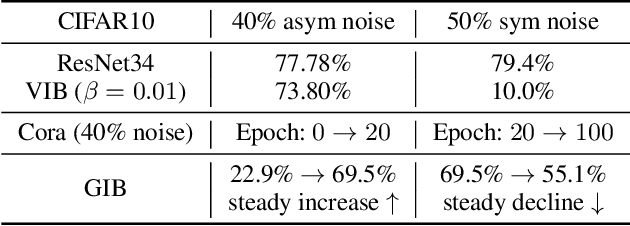
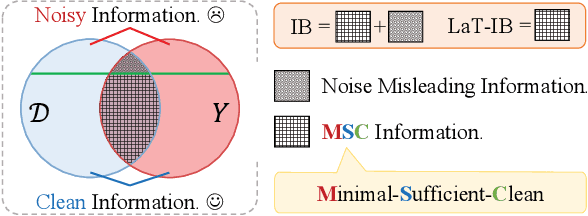
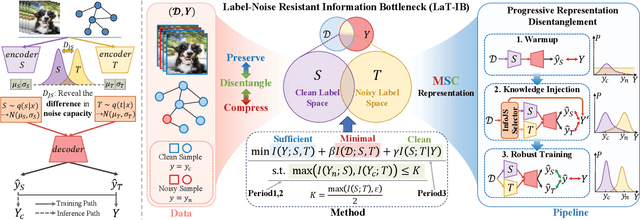
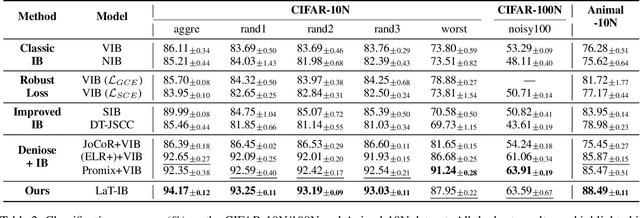
The Information Bottleneck (IB) principle facilitates effective representation learning by preserving label-relevant information while compressing irrelevant information. However, its strong reliance on accurate labels makes it inherently vulnerable to label noise, prevalent in real-world scenarios, resulting in significant performance degradation and overfitting. To address this issue, we propose LaT-IB, a novel Label-Noise ResistanT Information Bottleneck method which introduces a "Minimal-Sufficient-Clean" (MSC) criterion. Instantiated as a mutual information regularizer to retain task-relevant information while discarding noise, MSC addresses standard IB's vulnerability to noisy label supervision. To achieve this, LaT-IB employs a noise-aware latent disentanglement that decomposes the latent representation into components aligned with to the clean label space and the noise space. Theoretically, we first derive mutual information bounds for each component of our objective including prediction, compression, and disentanglement, and moreover prove that optimizing it encourages representations invariant to input noise and separates clean and noisy label information. Furthermore, we design a three-phase training framework: Warmup, Knowledge Injection and Robust Training, to progressively guide the model toward noise-resistant representations. Extensive experiments demonstrate that LaT-IB achieves superior robustness and efficiency under label noise, significantly enhancing robustness and applicability in real-world scenarios with label noise.
Toward a Unified Geometry Understanding: Riemannian Diffusion Framework for Graph Generation and Prediction
Oct 06, 2025Graph diffusion models have made significant progress in learning structured graph data and have demonstrated strong potential for predictive tasks. Existing approaches typically embed node, edge, and graph-level features into a unified latent space, modeling prediction tasks including classification and regression as a form of conditional generation. However, due to the non-Euclidean nature of graph data, features of different curvatures are entangled in the same latent space without releasing their geometric potential. To address this issue, we aim to construt an ideal Riemannian diffusion model to capture distinct manifold signatures of complex graph data and learn their distribution. This goal faces two challenges: numerical instability caused by exponential mapping during the encoding proces and manifold deviation during diffusion generation. To address these challenges, we propose GeoMancer: a novel Riemannian graph diffusion framework for both generation and prediction tasks. To mitigate numerical instability, we replace exponential mapping with an isometric-invariant Riemannian gyrokernel approach and decouple multi-level features onto their respective task-specific manifolds to learn optimal representations. To address manifold deviation, we introduce a manifold-constrained diffusion method and a self-guided strategy for unconditional generation, ensuring that the generated data remains aligned with the manifold signature. Extensive experiments validate the effectiveness of our approach, demonstrating superior performance across a variety of tasks.
Controllable Logical Hypothesis Generation for Abductive Reasoning in Knowledge Graphs
May 27, 2025Abductive reasoning in knowledge graphs aims to generate plausible logical hypotheses from observed entities, with broad applications in areas such as clinical diagnosis and scientific discovery. However, due to a lack of controllability, a single observation may yield numerous plausible but redundant or irrelevant hypotheses on large-scale knowledge graphs. To address this limitation, we introduce the task of controllable hypothesis generation to improve the practical utility of abductive reasoning. This task faces two key challenges when controlling for generating long and complex logical hypotheses: hypothesis space collapse and hypothesis oversensitivity. To address these challenges, we propose CtrlHGen, a Controllable logcial Hypothesis Generation framework for abductive reasoning over knowledge graphs, trained in a two-stage paradigm including supervised learning and subsequent reinforcement learning. To mitigate hypothesis space collapse, we design a dataset augmentation strategy based on sub-logical decomposition, enabling the model to learn complex logical structures by leveraging semantic patterns in simpler components. To address hypothesis oversensitivity, we incorporate smoothed semantic rewards including Dice and Overlap scores, and introduce a condition-adherence reward to guide the generation toward user-specified control constraints. Extensive experiments on three benchmark datasets demonstrate that our model not only better adheres to control conditions but also achieves superior semantic similarity performance compared to baselines.
Galaxy Walker: Geometry-aware VLMs For Galaxy-scale Understanding
Mar 24, 2025Modern vision-language models (VLMs) develop patch embedding and convolution backbone within vector space, especially Euclidean ones, at the very founding. When expanding VLMs to a galaxy scale for understanding astronomical phenomena, the integration of spherical space for planetary orbits and hyperbolic spaces for black holes raises two formidable challenges. a) The current pre-training model is confined to Euclidean space rather than a comprehensive geometric embedding. b) The predominant architecture lacks suitable backbones for anisotropic physical geometries. In this paper, we introduced Galaxy-Walker, a geometry-aware VLM, for the universe-level vision understanding tasks. We proposed the geometry prompt that generates geometry tokens by random walks across diverse spaces on a multi-scale physical graph, along with a geometry adapter that compresses and reshapes the space anisotropy in a mixture-of-experts manner. Extensive experiments demonstrate the effectiveness of our approach, with Galaxy-Walker achieving state-of-the-art performance in both galaxy property estimation ($R^2$ scores up to $0.91$) and morphology classification tasks (up to $+0.17$ F1 improvement in challenging features), significantly outperforming both domain-specific models and general-purpose VLMs.